Moka Pot Puck Prep: Advanced Distribution Techniques
Update on Oct. 11, 2025, 5:10 a.m.
You’ve moved past the beginner’s phase. You use pre-heated water, you’ve dialed in your grind, and you know exactly when to pull the Moka pot off the heat. Your coffee is consistently good. But “good” is no longer enough. You’re chasing “perfect”—that elusive brew that is sweet, rich, and complex, with no hint of bitterness. You’re ready to talk about puck prep.
In the world of high-end espresso, “puck prep” is an obsessive, multi-step ritual. For the Moka pot, it doesn’t need to be so complex, but the underlying principle is identical. The goal is to transform a chaotic pile of grounds into a perfectly engineered puck of uniform density.
Our true enemy isn’t bitterness itself; it’s density variance. Every clump, every air pocket, is a potential channel waiting to happen. Here, we explore the primary schools of thought on how to combat it, treating each as a valid workflow with its own pros and cons.
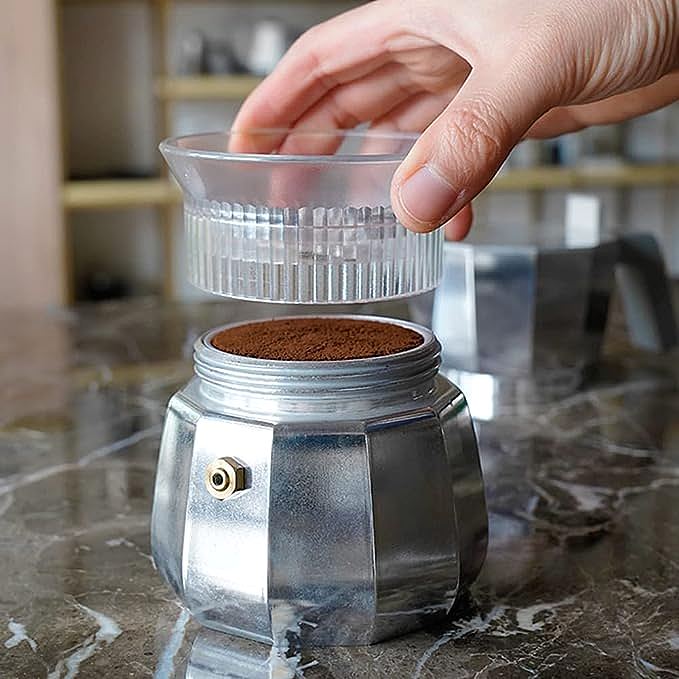
Method 1: The Purist (Tapping & Leveling)
This is the simplest, tool-free approach. It relies on gravity and manual dexterity.
- The Technique: After dosing the coffee into the filter basket, you gently tap the side of the basket with your hand. This helps the grounds settle and encourages larger voids to collapse. You then use your finger to level the surface, swiping off any excess.
- The Physics: Tapping uses vibration to break down the most egregious structural instabilities. It’s a low-fidelity method of increasing the overall density and uniformity.
- Pros: Fast, free, requires no extra equipment.
- Cons: Ineffective against smaller, internal clumps (micro-clumps). The “settling” can sometimes create its own layers of density. Repeatability is highly dependent on user skill. It mitigates the worst offenses but rarely perfects the bed.
Method 2: The Surgeon (Weiss Distribution Technique - WDT)
To fight the hidden micro-clumps, we need to borrow a technique from the professional espresso world. We need to perform surgery.
- The Technique: The Weiss Distribution Technique involves using a set of fine needles (or a paperclip, or a specialized tool) to stir the coffee grounds in the basket. The goal is to break up every single clump, resulting in a fluffy, homogenous bed of coffee.
- The Physics: WDT is a direct, mechanical intervention to de-clump and homogenize the grounds. It actively randomizes the particle distribution, creating a very consistent density throughout the entire puck.
- Pros: Extremely effective at eliminating clumps and creating a uniform bed. Can be done with simple DIY tools.
- Cons: Can be messy without a funnel to contain the grounds. The process itself can feel fussy and adds time to the routine.
Method 3: The Engineer (Dosing Funnels & Levelers)
The mess and fuss of WDT created a market for a more elegant, engineered solution. This marks the shift from pure technique to purpose-built technology. These tools typically address two or three problems at once.
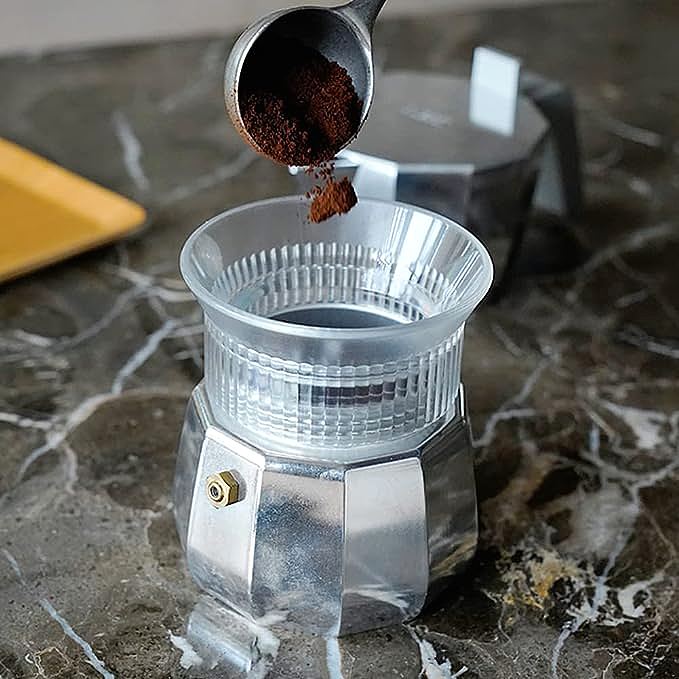
- The Technique: A dosing funnel is placed on top of the filter basket. This provides a wider target for your grinder, achieving Containment (no mess). It also allows you to perform WDT without spilling. Some funnels, like the watchget model, are also shaped to act as a Distributor. After dosing, a few rotations of the funnel itself can help to level and settle the grounds in a controlled manner.
- The Physics: These tools create a controlled environment. The funnel walls prevent spillage, and the rotational action provides a consistent, repeatable force to level the bed, which is more reliable than tapping. It streamlines the workflow, combining dosing and distribution into a single, clean step.
- Pros: Clean, highly repeatable, combines multiple steps into one. Lowers the skill barrier to achieving a uniform puck.
- Cons: Requires purchasing another piece of equipment. The effectiveness of the “distribution” feature can vary by design.
Conclusion: Choosing Your Workflow, Not Just Your Tool
There is no single “best” method. The goal is not to own the most tools, but to achieve the most consistent result.
- If you value speed and simplicity, mastering the Purist’s tap-and-level technique will get you 80% of the way there.
- If you are a perfectionist seeking to eliminate every possible variable, the Surgeon’s WDT approach is undeniably the most thorough.
- If you value cleanliness, repeatability, and a streamlined process, the Engineer’s path with a dosing funnel offers a compelling balance of convenience and performance.
Ultimately, the art of the puck is about acknowledging a problem—density variance—and deliberately choosing a workflow to solve it. Whether by hand, needle, or tool, taking control of your coffee bed is the final step in elevating your Moka pot from a simple coffee maker into an instrument of precision.


