Precision and Purity: Mastering Extraction and Static with the Aromaster CG204
Update on Jan. 8, 2026, 7:38 a.m.
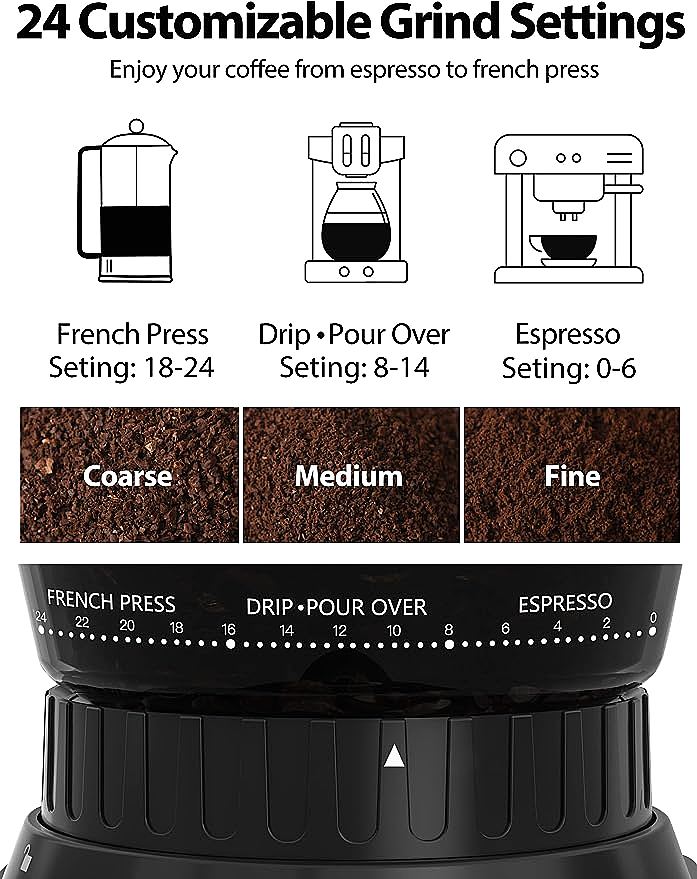
If the burrs are the heart of a grinder, the adjustment mechanism is its brain. The ability to dictate the exact size of thousands of coffee particles is what separates a tool from a toy. The Aromaster CG204 offers 24 distinct grind settings, a feature that might seem like overkill to the casual observer but is essential for the serious enthusiast. This granularity allows the user to navigate the entire spectrum of extraction science.
However, creating the perfect grind is only half the battle. Delivering that grind cleanly into the brewing vessel—without the chaotic interference of static electricity—is the other half. This article explores the “software” side of the hardware: the physics of particle size adjustment, the impact of grind size on extraction yield, and the fascinating science behind the CG204’s anti-static technology.
The Spectrum of Extraction: Decoding the 24 Settings
Why do we need 24 settings? Why not just “Small, Medium, Large”? The answer lies in the non-linear relationship between surface area and extraction rate.
Coffee extraction is a diffusion process. Water penetrates the particle, dissolves solubles, and diffuses them back out.
* Surface Area: As particles get smaller, their total surface area increases exponentially. A fine espresso grind exposes massively more surface area than a coarse French Press grind.
* Resistance: In pressurized brewing (like espresso), the grind size also creates hydraulic resistance.
The Aromaster CG204’s 24 settings provide a continuum of control across this physical landscape. * Settings 1-6 (Fine / Espresso): Here, the burrs are nearly touching. The particles are microscopic. This creates the high resistance needed to build 9 bars of pressure in an espresso machine. A small adjustment here creates a huge difference in flow rate (e.g., a 25-second shot vs. a 35-second shot). * Settings 7-15 (Medium / Drip & Pour Over): The particles resemble sea salt. This is the “Goldilocks zone” for gravity-fed brewing. The grind must be uniform enough to allow water to flow through at a steady pace but fine enough to extract fully within 3-4 minutes. * Settings 16-24 (Coarse / French Press & Cold Brew): The particles are like breadcrumbs. The low surface area slows down extraction, which is perfect for immersion methods where coffee and water sit together for minutes (French Press) or hours (Cold Brew).
The precision of the CG204 allows the user to dial in their brew. If a pour-over tastes bitter (over-extracted), moving from Setting 10 to Setting 12 reduces the surface area slightly, slowing extraction and restoring sweetness. This adjustability turns the user from a passive consumer into an active calibrator of flavor.

The Physics of Mess: Static Electricity
One of the most persistent annoyances in coffee grinding is static cling. When coffee beans are shattered, electrons are transferred between particles and the grinder walls through the Triboelectric Effect. * Dryness: Roasted coffee is very dry (low moisture content). Dry materials are excellent insulators, meaning they hold onto electric charges rather than dissipating them. * The Result: Positively charged coffee dust repels other positive particles and attracts to negatively charged surfaces (like the plastic bin or the counter). This leads to “flying grounds” and a messy workspace.
The Aromaster Anti-Static Solution
The CG204 incorporates Upgraded Anti-Static Technology. While manufacturers rarely disclose the exact engineering, anti-static systems in grinders typically rely on charge neutralization or conductive pathways.
By using materials or discharge points that allow the static charge to bleed off safely before the coffee exits the chute, the CG204 ensures that the grounds fall vertically into the bin.
* Cleanliness: This keeps the kitchen counter clean.
* Dosing Accuracy: More importantly, it ensures that the coffee you weighed is the coffee you get. If 0.5g of coffee sticks to the chute due to static, your brew ratio is thrown off. Anti-static tech is, therefore, a flavor consistency feature as much as a convenience feature.
Preservation Science: UV Protection and Timers
The CG204’s design extends beyond the mechanics of grinding to the preservation of the ingredient. * UV Protection: The bean hopper and grounds bin feature a tawny (tinted) design. This is a specific countermeasure against Ultraviolet (UV) radiation. UV light accelerates the photodegradation of organic compounds in coffee, causing fats to turn rancid and aromatics to break down. The tinted plastic acts as a filter, extending the freshness of beans stored in the hopper. * The Timer Function: The built-in timer (adjustable seconds) introduces consistency in dosing. Once you know that 10 seconds yields 18 grams of coffee (for example), you can repeat this dose every morning with a single button press. This repeatability is the cornerstone of developing a good coffee routine.
Maintenance: The Cycle of Longevity
A precision tool requires maintenance. The CG204 features a removable upper burr and a built-in cleaning brush.
From a mechanical perspective, cleaning is vital for two reasons:
1. Hygiene: Coffee oils eventually go rancid. Old oil coating the burrs will impart a stale flavor to fresh beans.
2. Performance: Caked-on coffee fines can alter the geometry of the burr gap, throwing off the calibration.
The ability to easily disassemble the burr set without tools empowers the user to maintain the machine’s factory-level performance for years.
Conclusion: The Democratization of Precision
The Aromaster CG204 proves that high-quality coffee grinding is no longer the exclusive domain of expensive, commercial-grade equipment. By leveraging the physics of conical burrs, the material science of stainless steel, and smart anti-static engineering, it delivers a level of precision that was previously inaccessible at this price point.
It allows the home brewer to explore the full spectrum of coffee extraction—from the high-pressure intensity of espresso to the slow, cold extraction of cold brew—with a single, reliable instrument. It is a victory for the democratization of good coffee.


